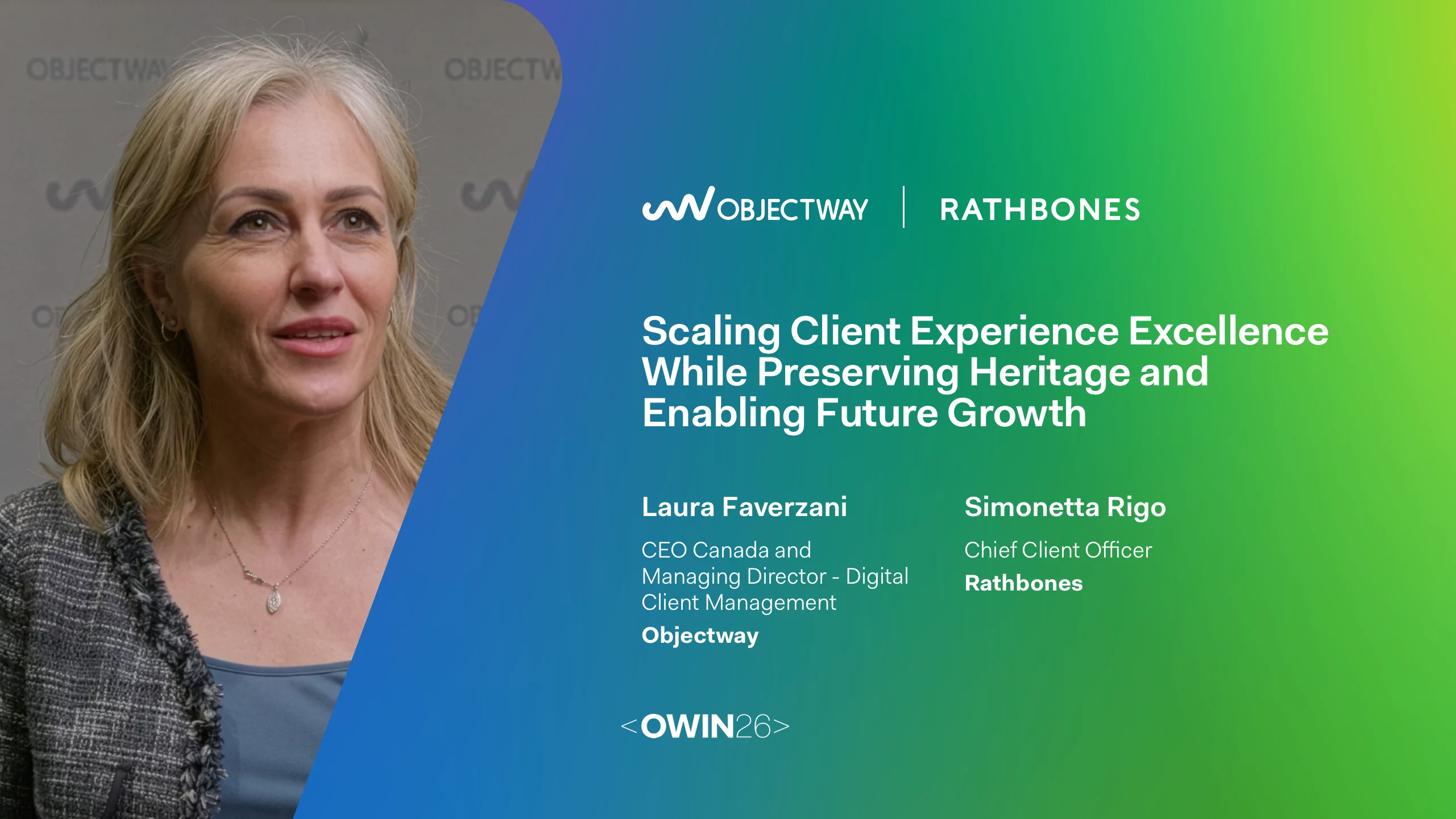
JUN 17, 2026
Personalisation at scale: Reimagining financial services through the lens of the experience
Communication Specialist, Objectway
About Objectway
Customer expectations are changing faster than many service models can keep pace with. Clients expect the same seamless, intuitive and personalised experiences they encounter in top-of-mind players across other industries – but in a context defined by complexity, regulation and trust.
They expect advice that is tailored to them, service that moves at speed, digital journeys that remove friction, and proactive anticipation of their needs. And increasingly, they expect to be active participants in the advice they receive. This creates both pressure and opportunity.
The data confirms it: at the client-facing edges of the business, where complexity naturally accumulates, progress is slower than many would expect. Only 14% of firms have achieved profitable scale, while 49% have begun implementing initiatives toward this goal but have not yet reached scalable profitability – a signal that many institutions have moved past early modernisation, but have not yet fully industrialised the workflows that matter most.
Because while personalisation has long been a cornerstone of wealth management, delivering it consistently, meaningfully and at scale is becoming a far more complex challenge. And perhaps nowhere is this clearer than in how the relationship between clients, advisors and technology is evolving.
“Clients no longer benchmark their bank against another bank — they benchmark it against the best experience they have had anywhere.” — Dr. Stefanie Auge-Dickhut, Head CC Future Financial Services at BEI St. Gallen .
Meeting that standard requires more than better technology. It requires a fundamentally different understanding of what clients want from their relationship with a financial institution – and what, increasingly, they are no longer willing to accept.
A different kind of investor, and advisor, is emerging
Something is shifting in the advisor’s office – and it is not the technology on the desk, nor the data on the screen. It is the client sitting across from it.
Edoardo Zavarella, Principal Consultant at Forrester, put it plainly at OWIN26: nearly a decade of investor research shows a clear and sustained movement away from delegation – the model in which clients trusted advisors to decide on their behalf – and toward something more participatory. Clients are arriving informed. They have done the research, processed the data, formed a view. What they are looking for, increasingly, is not an expert to follow but a thinking partner to engage with.
As Zavarella noted, “The closer you get to being a digital native… the more you like to operate in autonomy and actually make your research and pre-prepare when you talk to your financial advisor.”
That changes the advisor-client dynamic radically, and the advisor’s role in ways that go beyond process or tooling.
“Value is increasingly created less by the products we offer and more by the relevance, quality, and consistency of the advice surrounding them.” – Paolo Magnani, Deputy Managing Director at CREDEM
The advisor becomes less a gatekeeper of expertise and more its interpreter — someone who helps clients make sense of complexity rather than simply navigate it. He/she must rest on something harder to replicate:replicate: judgement, context, trust.
“So far financial advisors have acted as asset allocators,” Zavarella argued. “From now on they will have to add to their skill set the capacity to act as tech-enabled coaches: content curators.”
That evolution in the advisor’s role mirrors a broader shift in how clients move through their financial lives. Forrester’s research reveals that today’s clients orchestrate their own journeys – switching channels fluidly, blending digital and human interaction as naturally as the situation demands. Particularly striking is how narrow the gap has become between AI-enabled interactions and human-mediated ones. A client might use an AI assistant to review portfolio performance, arrive at an advisor meeting already oriented, and reserve that conversation for the kind of strategic dialogue for what experience, intuition and relationship have always done better than data alone.
The value of the human interaction, in other words, rises precisely as the basics are handled elsewhere.
Everything clients want — at scale
Four pillars are defining the modern customer experience in wealth management: personalisation, speed, self-service and proactive engagement. Individually, they are familiar concepts. Yet taken together, they imply a radically elevated service standard.
Personalisation now has to move beyond tailored recommendations toward deeply individualised relationships. Speed is no longer a differentiator – it is assumed. Whether onboarding, servicing or communication, clients increasingly see delays as design failures. Self-service has become equally essential, not simply as a convenience, but as an expression of autonomy. And the most ambitious of all is proactive engagement: the expectation that firms anticipate needs, surface opportunities and bring ideas before clients ask.
“The key is to be able to do all this at scale.” – Edoardo Zavarella
This is where AI enters the conversation less as disruption and more as an enabler.
It can support dynamic recommendations, power more intelligent self-service, reduce friction in processes, and help advisors engage clients more proactively.
More importantly, it shifts advisor capacity toward higher-value interactions. As routine information exchange becomes increasingly augmented, advisors can focus more on empathy, trust and strategy.
“Technology does not replace the advisor; it enables the advisor to deliver better, more personalised service at scale. AI and platforms are not substitutes for relationships — they are the infrastructure that allows relationships to deepen.”– Paolo Magnani, Deputy Managing Director at CREDEM
That potential, however, comes with conditions. In an industry extremely dependent on trust, the confidence clients place in AI tools is real but fragile – susceptible, as Zavarella cautioned, to the first significant public failure. Explainability, accountability, and regulatory alignment are the foundations on which sustainable adoption is built.
“The key leadership challenge in large institutions is navigating the trade-offs between governance, compliance, and innovation — not by choosing between them, but by finding a model where all can advance together.” – Maarten Lindner, Lead Investment Products at Rabobank
The real opportunity, it follows, lies not in isolated AI tools, but in orchestrated ecosystems — where data, agents, governance and human judgement work together.
“Innovation in AI will only scale when performance, trust, and compliance evolve together.”– Dr. Stefanie Auge-Dickhut, Head CC Future Financial Services at BEI St. Gallen
Research points to where the work begins. Leaders have automated far more aggressively than Followers – 83% vs 40% in Client Engagement & Collaboration, 80% vs 33% in Onboarding, KYC & AML – and are furthest ahead in areas that demand stronger data, integration and operating model maturity, including AI-driven personalisation and more advanced client engagement. But it is the foundations they built that have created the room for something this ambitious: by embedding client experience into the operating model and combining more efficient operations, with digital tooling and multi-channel capabilities, they have built the conditions for front-office innovation to scale.
A human story, enabled by technology
For all the discussion around AI, innovation, and digital transformation, the most compelling vision emerging is surprisingly human. Technology is not making personal relationships less important. It is raising the bar around how meaningful they need to be.
Future differentiation will depend less on digital capability alone and more on how effectively organisations combine data-driven intelligence with human judgement – a model where technology extends, rather than replaces, advisory expertise. What once felt like opposing forces — scale and personalisation — is becoming a design challenge. And that is probably the most important shift of all: not a technological one, but a change in what technology is ultimately for. Richer relationships, at a scale that was never before within reach.