July 06, 2026
Scaling Through Complexity: Automation and Repeatability in Financial Services
Marketing & Communication Specialist
market trends
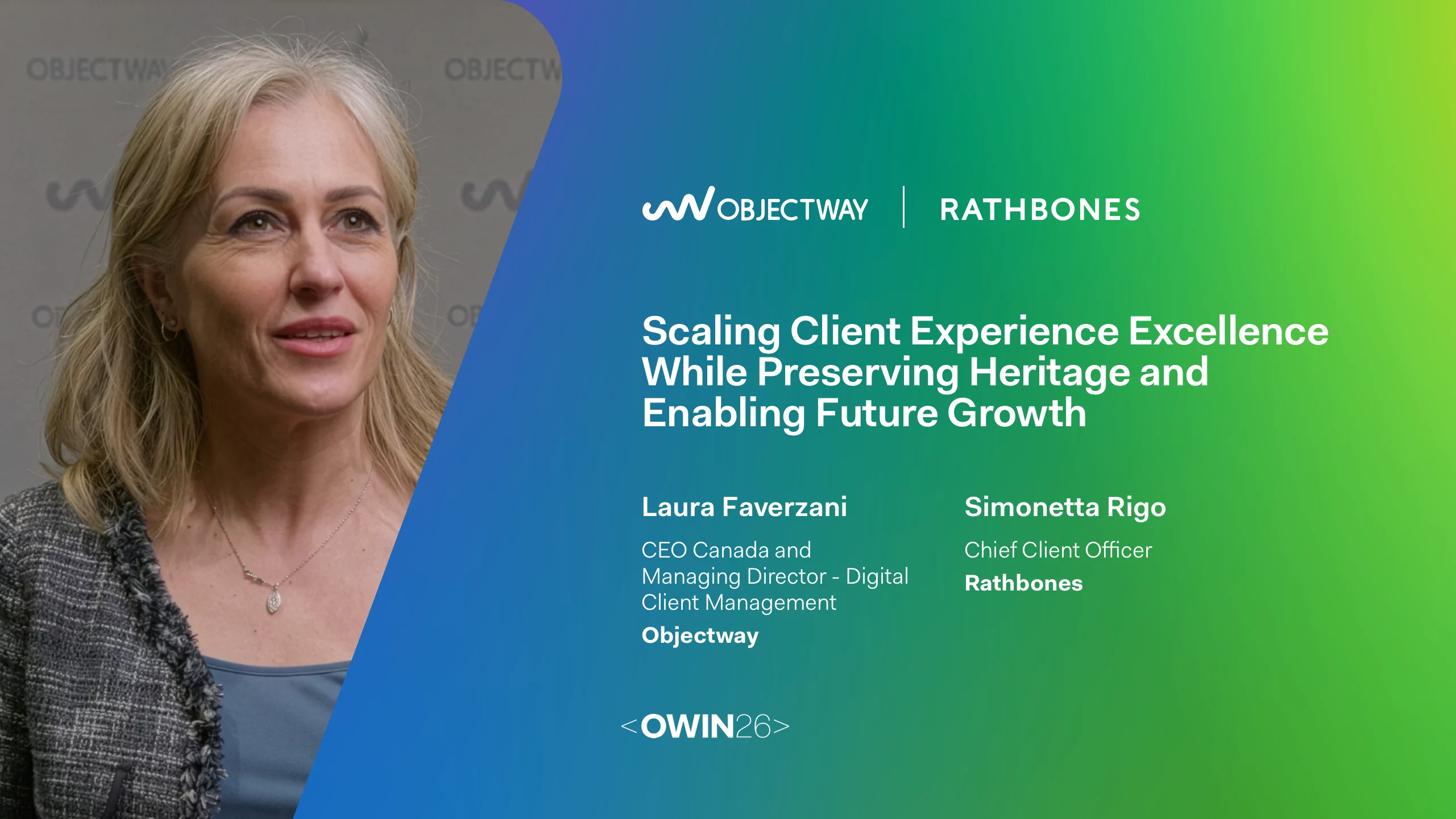
At Objectway’s recent customer conference in Sorrento, industry leaders, executives, and experts convened to address one of the defining challenges of modern financial services: managing complexity while driving scalable growth.
Chaired by Leda Glyptis, renowned Author and Advisor, the OWIN26 Customer Conference explored how organisations can move beyond incremental innovation and build the structural foundations required for long-term competitiveness, profitability, and resilience.
Navigating Complexity with Intentional Design
A recurring thread throughout the conference was the recognition that complexity is not a temporary obstacle, but a structural consequence of growth. As Leda Glyptis noted, “success creates complexity. Longevity creates complexity. Scale creates complexity.”
This acknowledgement sets the tone for a necessary shift in mindset. Rather than attempting to eliminate complexity, leading institutions are learning to design around it—treating it as something to be shaped and governed. Left unmanaged, complexity becomes a source of friction; addressed strategically, it creates room for differentiation and long-term value creation.
This shift naturally leads to a more fundamental question: what distinguishes organisations that successfully leverage complexity from those that are constrained by it?
The Critical Role of Strong Foundations
The answer, as highlighted during the conference, lies in the quality of underlying foundations. Firms that have invested in simplifying their operating models, consolidating data, and addressing legacy fragmentation are already realising measurable advantages in profitability and performance.
However, these outcomes require more than incremental change. They demand confronting issues that have historically been deferred. Leda captured this dynamic concisely when describing how the industry often labels such challenges as “complicated”—a term that frequently stands in for deeper concerns around cost, risk, and difficult decisions.
In this context, addressing complexity is less about technological upgrades and more about organisational resolve: the willingness to simplify where it matters most.
From Operational Friction to Strategic Capability
This is where automation and repeatability come into focus, not as isolated initiatives, but as critical enablers of scale. As Leda emphasised, “automation, repeatability and reduced complexity is where the uplift is realised.”
The conversation naturally converged on operational processes that have long resisted transformation—most notably client onboarding, often referred to as a persistent “hairy beast.”
What emerged clearly is that these areas are no longer peripheral concerns. They sit at the core of competitiveness, directly impacting speed, client experience, and the ability to respond to market demands.
By embedding consistency and automation into these processes, organisations can begin to convert operational friction into strategic capability—laying the groundwork for more scalable and resilient growth.
AI as a Multiplier of What Already Exists
Building on this foundation, the role of artificial intelligence was framed with pragmatic clarity. While AI continues to dominate industry discourse, the conference reinforced that its impact is largely determined by organisational readiness.
In environments where data is clean, systems are integrated, and processes are streamlined, AI acts as a powerful accelerator of value creation. In less mature environments, however, it risks amplifying inefficiencies and exposing structural weaknesses.
This reinforces a broader conclusion that ran throughout the discussions: innovation alone is not the differentiator. The real advantage lies in the ability to operationalise it—consistently, at scale, and without introducing new layers of complexity.
From Awareness to Action
As the conference ended, the conversation returned to a theme of urgency. The industry is no longer short of ideas, technologies, or awareness. What distinguishes leaders is their willingness to act decisively.
Leda caught this feeling in a closing reflection: “The best time to make a change was the first time we realised that what we had wasn’t what we needed. The second-best time… is now.”
In a landscape where complexity will only continue to increase, the path forward is becoming clearer. Organisations that prioritise simplification, invest in strong foundations, and embed automation and repeatability into their operating models will be best positioned to scale effectively. Those that hesitate will find that complexity compounds—while the time available to address it continues to shrink.
Ultimately, managing complexity is no longer just an operational necessity; it is a defining capability for sustainable success in financial services.